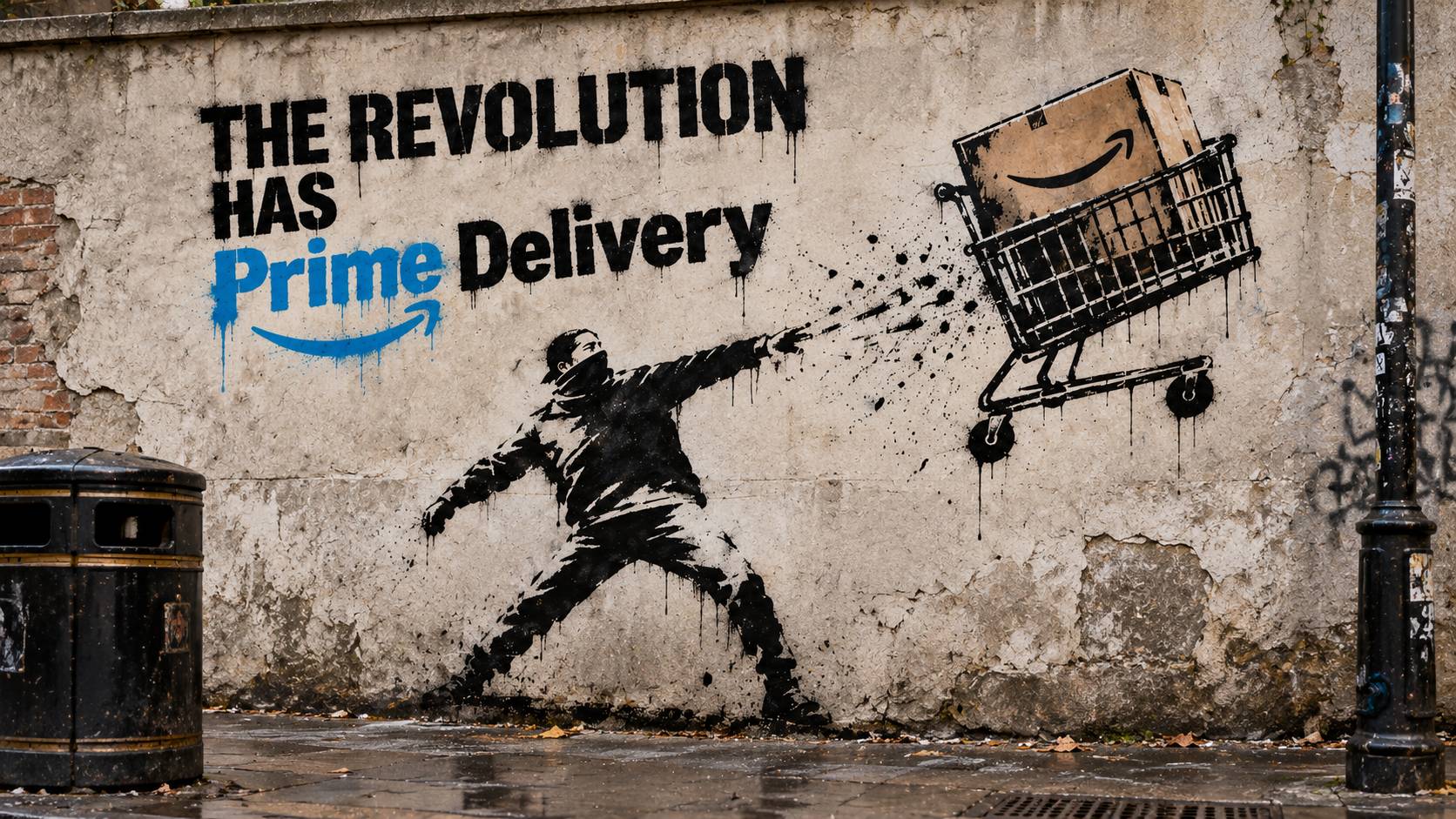
The Revolution Has Prime Delivery
A few days ago another challenger stepped into one of the hardest fights in European retail. easyShop, carrying the familiar orange identity of the easy family of brands, says it is now live across 21 European countries. Operated by OnCommerce - the company behind OnBuy - the new marketplace is positioning itself explicitly as an alternative to Amazon. Hundreds of retailers are already trading, according to the company, and more are being recruited in time for the Christmas shopping season.
It is an eye-catching launch. It is also a useful reminder that launching an online marketplace and building an online marketplace are two very different things. Putting millions of products onto a website is a technology problem. Persuading people to change a shopping habit built over years is a behavioral problem. And that second problem is the reason Europe has produced plenty of credible e-commerce companies but no simple pan-European replacement for Amazon.
A different kind of challenger
easyShop is not starting completely from scratch. When easyGroup announced the project in June it said the marketplace would use technology originally developed for OnBuy. OnCommerce has since developed that idea into a broader retail network: sellers can use one account and one fee structure while their products are distributed across eligible OnCommerce channels including OnBuy, easyShop and eventually Comet.
That architecture might turn out to be the most important part of the story. The conventional way to launch a marketplace is to build a new consumer brand and then persuade merchants to integrate with it. But merchants have limited engineering time, advertising budgets, inventory and staff. Integrating with an unknown marketplace that has few buyers is difficult to justify.
OnCommerce is trying to change that calculation. A retailer already connected to its network does not necessarily have to treat easyShop as an entirely separate technical project. The same catalogue can potentially reach several storefronts and countries. OnCommerce also promises automatic VAT calculations while the wider EU VAT One Stop Shop already reduces some of the administrative burden of cross-border distance selling. That makes it easier to solve the supply side of the marketplace problem.
easyShop also has a clear pitch to merchants. It says it will not stock products itself, create own-brand competitors or sell against the retailers using the platform. That is more than a branding detail. It is an attempt to persuade sellers that easyShop's incentives will remain aligned with theirs: the platform makes money when the merchant makes a sale.
Then there is the easy name. A completely unknown marketplace launching simultaneously in Germany, France, Italy, Spain, Poland and the Nordics would face an enormous trust problem. easyShop arrives attached to a family of brands whose roots go back to easyJet and three decades of European consumer marketing. That does not guarantee that anybody will buy a laptop or vacuum cleaner there but recognition gives the company a better starting point than most marketplace start-ups receive.
The live storefront shows how quickly the supply side can be assembled. easyShop is already displaying familiar products from companies such as Apple, Samsung, Bose and Canon alongside a long tail of tools, health, beauty and household merchandise. Many listings advertise free delivery.

So why should this be difficult?
Because having products is not the same as having a marketplace. The flywheel easyShop has to start Marketplaces have an unusually unforgiving economic structure.
Imagine opening a traditional shop. Add another good product to its shelves and the shop becomes slightly better. A marketplace works differently. Its value depends on two populations that need each other. Sellers want buyers. Buyers want sellers. More buyers make the platform worth more to merchants; more merchants create better selection and competition making it more useful to buyers. Economists call this an indirect network effect. Once enough momentum develops it can produce a self-reinforcing flywheel.
The brutal part is what happens before the flywheel starts.
Suppose easyShop recruits another 5,000 merchants. That sounds impressive in a press release. But what matters to each merchant is not the number of fellow sellers. It is whether orders arrive. If sales remain sparse sellers may technically stay on the platform while doing very little to support it. Their best inventory goes elsewhere. They stop optimizing listings. Their sharpest prices appear on channels with more volume. They devote advertising money to marketplaces where customers already exist.
This is an underappreciated feature of e-commerce competition: merchants can multi-home. A seller can list on Amazon, eBay, OnBuy, Allegro and easyShop at the same time. Therefore signing a merchant does not mean winning that merchant's attention.
The buyer side is harder still. Amazon's strongest European asset is not its homepage. It is what happens in a shopper's head before the homepage appears.
When somebody needs headphones, a cable, coffee filters or a replacement part where do they start? For a large number of customers the answer is already Amazon. Similarweb's September 2026 estimates illustrate the depth of that habit in Germany: Amazon.de ranked first among marketplace sites and 51.8% of its desktop visits were classified as direct traffic. Amazon.es also ranked first among marketplace websites in Spain.
That is a formidable advantage. A challenger has to spend money or offer something meaningfully different to interrupt a shopping journey that the incumbent receives almost automatically. Then, after getting the visit, it needs to match the expectations Amazon helped create: a broad assortment, recognizable sellers, useful reviews, predictable returns, competitive prices and delivery that feels effortless.
The last point is especially important. It is tempting to describe Amazon as a website. Increasingly, it makes more sense to think of it as a logistics and membership system with a marketplace attached.
Consider the strategy of another 2026 challenger JD.com's Joybuy. Its European launch covered only six markets rather than easyShop's 21 but JD brought roughly 60 warehouses and depots, its own last-mile capability and same-day delivery availability for more than 15 million households. It even launched a low-priced delivery membership designed to compete with Prime. easyShop has made the opposite choice. By holding no inventory it avoids the extraordinary capital requirements of building an Amazon-style fulfilment network. That makes rapid international expansion much easier.
But the strength is also a weakness. When independent merchants fulfil the orders, the marketplace has less direct control over how uniform the customer experience feels.
The consumer does not care which company technically caused a late parcel. The consumer remembers which website took the order.
That is why a marketplace can have excellent technology, reasonable commissions and millions of listings and still fail to generate a consumer habit.
And the incumbent can fight back.
Amazon cut a series of European seller charges in late 2025 as competition from Temu and Shein intensified. Referral fees on some low-priced fashion products fell, lower-priced home goods received reductions and fulfilment charges were cut across several large European stores. This is another feature of attacking a platform with network effects: the incumbent is not frozen in time. A challenger cannot design its offer against today's Amazon and assume today's Amazon will still be waiting when the challenger gains traction.

Winning does not require killing Amazon
There is good news for easyShop. Europe already contains evidence that Amazon's dominance is neither universal nor inevitable. In the Netherlands and Belgium bol has built a formidable local ecosystem. It reported 14 million active customers and about 43,000 sales partners in 2026. In Poland Allegro has constructed something closer to a complete commerce system. It ended 2025 with 15.3 million active buyers in Poland alone, alongside its Smart loyalty programme, payments and a growing delivery network incorporating tens of thousands of lockers and pickup points. Zalando chose specialization rather than trying to be everything to everyone from day one. Its focus on fashion has grown into a platform spanning 29 markets and roughly 62 million active customers, with about €17.6 billion in 2025 GMV.
The lesson from these businesses is not that somebody has discovered the formula for “killing Amazon.” It is almost the opposite.
Successful European alternatives tend to win a specific reason to exist. They may have exceptional local density, a category advantage, a loyalty programme, stronger regional logistics, distinctive pricing or a relationship with merchants and customers that an international generalist cannot easily reproduce. easyShop therefore does not need to persuade Europe to uninstall Amazon. It needs to give enough people a reason to open easyShop too.
That difference sounds small, but strategically it changes everything. A sensible path would be to concentrate demand rather than celebrating footprint. Being technically available in 21 countries has marketing value but marketplaces live or die on density. Ten thousand transactions concentrated in one category and city can create useful reviews, seller economics and repeat behavior. The same number scattered across 21 countries and hundreds of categories may barely be visible.
Europe's e-commerce opportunity is large enough to support more than one winner. In 2025 78% of EU internet users had bought something online while estimates from ECDB put marketplaces at about 61% of European e-commerce GMV. The question is not whether Europeans are willing to shop online. That battle was settled years ago.
The question is where they instinctively go first.
This is where easyShop's unusual OnCommerce structure becomes interesting again. Instead of trying to manufacture a giant marketplace network from a single consumer brand OnCommerce is effectively asking whether the supply network can sit underneath several brands. Sellers join the infrastructure once; consumer-facing identities can then target different audiences.
In theory that could lower the cost of launching future marketplaces dramatically. But there is an asymmetry. A shared backend can reuse inventory data, merchant relationships, tax systems and software. It cannot simply copy consumer loyalty. A shopper loyal to easyJet does not automatically become loyal to easyShop. A customer who trusts OnBuy does not automatically visit Comet. The technology can connect the supply but each consumer brand still has to earn demand.
That is why the next easyShop announcement worth watching will not be another country launch. Nor will it be another enormous product count. The meaningful signals will be quieter: how often first-time customers return; whether merchants receive enough orders to keep prices competitive; whether delivery is dependable across sellers; whether buyers begin typing easyShop into their browsers without first seeing an advert; whether a rewards programme creates genuine loyalty rather than subsidized transactions.
Those are the moments when a marketplace stops being a website and starts becoming a network.
Amazon spent decades creating one of those networks. easyShop has found a clever way to avoid beginning entirely from zero borrowing OnCommerce's seller infrastructure and the easy brand's recognition while promising merchants a platform that will not become their retailer competitor.
That gives it a credible opening. It does not give it Amazon's flywheel.
And that is the larger lesson behind Europe's repeated search for an “Amazon killer”. The hard part has never been building another place where people can shop. Europe has plenty of those. The hard part is building a place where millions of people remember to shop without being reminded.
Until a challenger crosses that threshold Amazon's deepest competitive advantage is not its catalogue, its website or even its warehouses.
It is the habit that says: I need something. I'll look there first.
easyShop does not have to break that habit completely to succeed.
But it does have to become a habit of its own.